
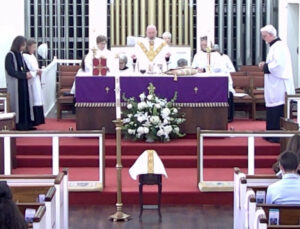
 As of this weekend, we are scheduling the eighth funeral at Christ Church since I arrived at the beginning of the year. That is, from my perspective, a gracious plenty for now, so maybe we could all try to hold off on the dying for a while. Some folks have noticed, though, that I use a different array of colors for funerals than they’re accustomed to, so I thought it might be helpful to share with you my reasoning behind it and some other thoughts about colors and liturgy in general.
First, all liturgical color schemes are in some sense made up. The only color that the early church really paid attention to was the white robe people were dressed in after they were baptized. That vestment still exists in the form of the alb, the long white robe clergy wear for Eucharistic services. All the other outer vestments, along with their colors, developed over the course of centuries, and different meanings were attached to those colors over time. Different places sometimes developed their own patterns and customs, and what we use now is sort of a mix of different traditions. We mostly follow what’s called the Gallican tradition from continental Europe, and that’s as far into the historical liturgical weeds as I want to go right now.
My approach to all things liturgical centers around one key thought – have a good reason for what we do. If someone asks why we do something in the liturgy, I believe we ought to have an explanation for it. If we don’t know why we’re doing a thing, we might want to stop doing it until we have at least thought it through. “Because that’s the way I like it” is probably not the best answer, although truth be told, all clergy use that one sometimes.
Now, when it comes to funeral colors, some of you have noticed that we’ve been using purple hangings on the ambo and altar instead of the white, and several of you have asked about that. Until the 1979 Book of Common Prayer, the color appointed for funeral hangings and vestments had always been purple. In the church, we associate purple with the penitential seasons of Lent and Advent, in which we are called to reflect upon our mortality and our need for God’s grace and mercy. In those earlier editions of the Prayer Book, the Burial Office also emphasized our need for forgiveness, particularly as we faced the end of our mortal life. In the Church’s eyes, purple was the appropriate color.
When our current Prayer Book was developed, we sought to recapture the ancient Church’s annual cycle of worship that centered on The Great Vigil of Easter. The rest of the liturgical year revolved around that feast. Eucharist became the principal act of worship on Sunday, and the whole sense of the Prayer Book moved more towards resurrection and new life than repentance. It’s when we really embraced the idea that “Every Sunday is Easter.” While I appreciate the shift in theology, I think we may have allowed the pendulum to swing too far. The joy of Easter Day draws its meaning from the grief and anguish of Good Friday; Grace only matters if we have need of it. We only know we need it if we are aware of our fallenness; that awareness can only come from self-examination; self-examination leads us to repentance. Funerals rightly focus on the Resurrection, but we still need to keep sight of why Jesus died in the first place.
It is to that end that some time ago I adopted a practice some parts of the Church follow – to use a mix of both purple and white at funerals. The altar is dressed in purple, but the clergy wear white vestments. All of this is summed up beautifully in a part of the The Commendation found on page 499 in The Book of Common Prayer. It’s a hymn traditionally called the Kontakion and comes from the Eastern Orthodox. The last two sentences say this:
“You are dust, and to dust you shall return.”
All of us go down to the dust;
yet even at the grave we make our song:
Alleluia, alleluia, alleluia.
Notice that in those words we have the language of both Ash Wednesday and of Easter Day – “you are dust” and the three-fold Alleluia. We don’t get the one without the other. Using both purple and white for funerals allows us to embody in the liturgy what we say we
believe.
The color scheme that we use for liturgy may be somewhat made up, but that doesn’t mean that what we use (and when) has no meaning. It does matter, and I’m grateful for the opportunity to share with you my reasoning about it. This short explanation, like virtually everything I write in this space, is never meant to be the final word. I hope you will treat it as an invitation to a deeper conversation, should you want to have one.
The Peace of Christ,
Fr Kevin