by ccvadmin | Jun 24, 2026 | Article
May the words of my lips and the meditations of all our hearts be always acceptable in your sight, O Lord, our Rock and our Redeemer.
Amen.
Please be seated.
I’m going to do something that my homiletics professor would be furious with me for.
You’re not supposed to let anything come between the reading of the gospel and the preaching of the homily.
There’s a theological reason.
Those two things are connected.
But there’s also a rhetorical reason.
That is the one moment where you have everybody’s attention, which is exactly why I want to say now what I want to say rather than saying it later in the service when I might not have your attention.
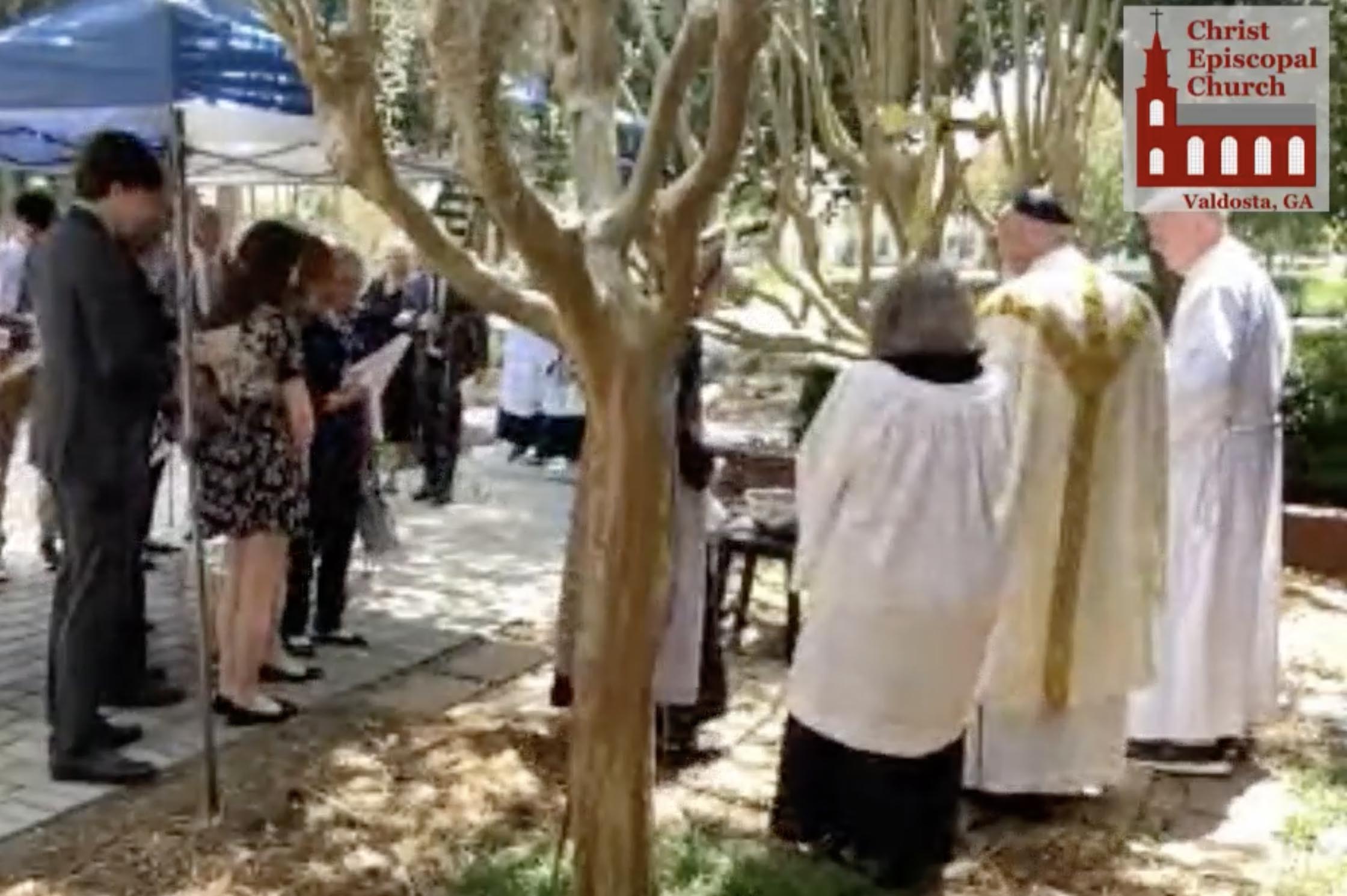
And that is that yesterday afternoon we had the Requiem Mass for Jim Hill.
And throughout the day at the reception and even afterwards, people kept either saying to me in person or texting me, thanking me for the service and telling me how lovely it was.
And here’s the thing.
When you’re the celebrant at a Requiem Mass, the prayer book does all the heavy lifting for you.
It really got that service right.
And in the role that I had, all I have to do is read what’s in front of me, not mess it up, and it does its job.
But the whole service was lovely. The music, flowers, the reception, the altar. We had a tent set up outside in case of rain, which then protected the family from the sun. There were gracious people here to greet guests and the family as they arrived.
And that is the eighth funeral here since I got here at the beginning of the year.
And they have all been like that.
Those services have been lovely because of the work and presence and love of the people in this congregation.
And I really want to thank you for that. On behalf of all of those families, you are a gift to them, you are a gift to God, and you are a gift to me.
And while I had your attention, I wanted to give credit where credit was due for what happened yesterday and during all of those other services.
Originally delivered as a preface to the sermon on June 21, 2026
by ccvadmin | Jun 12, 2026 | Letters
 As of this weekend, we are scheduling the eighth funeral at Christ Church since I arrived at the beginning of the year. That is, from my perspective, a gracious plenty for now, so maybe we could all try to hold off on the dying for a while. Some folks have noticed, though, that I use a different array of colors for funerals than they’re accustomed to, so I thought it might be helpful to share with you my reasoning behind it and some other thoughts about colors and liturgy in general.
First, all liturgical color schemes are in some sense made up. The only color that the early church really paid attention to was the white robe people were dressed in after they were baptized. That vestment still exists in the form of the alb, the long white robe clergy wear for Eucharistic services. All the other outer vestments, along with their colors, developed over the course of centuries, and different meanings were attached to those colors over time. Different places sometimes developed their own patterns and customs, and what we use now is sort of a mix of different traditions. We mostly follow what’s called the Gallican tradition from continental Europe, and that’s as far into the historical liturgical weeds as I want to go right now.
My approach to all things liturgical centers around one key thought – have a good reason for what we do. If someone asks why we do something in the liturgy, I believe we ought to have an explanation for it. If we don’t know why we’re doing a thing, we might want to stop doing it until we have at least thought it through. “Because that’s the way I like it” is probably not the best answer, although truth be told, all clergy use that one sometimes.
Now, when it comes to funeral colors, some of you have noticed that we’ve been using purple hangings on the ambo and altar instead of the white, and several of you have asked about that. Until the 1979 Book of Common Prayer, the color appointed for funeral hangings and vestments had always been purple. In the church, we associate purple with the penitential seasons of Lent and Advent, in which we are called to reflect upon our mortality and our need for God’s grace and mercy. In those earlier editions of the Prayer Book, the Burial Office also emphasized our need for forgiveness, particularly as we faced the end of our mortal life. In the Church’s eyes, purple was the appropriate color.
When our current Prayer Book was developed, we sought to recapture the ancient Church’s annual cycle of worship that centered on The Great Vigil of Easter. The rest of the liturgical year revolved around that feast. Eucharist became the principal act of worship on Sunday, and the whole sense of the Prayer Book moved more towards resurrection and new life than repentance. It’s when we really embraced the idea that “Every Sunday is Easter.” While I appreciate the shift in theology, I think we may have allowed the pendulum to swing too far. The joy of Easter Day draws its meaning from the grief and anguish of Good Friday; Grace only matters if we have need of it. We only know we need it if we are aware of our fallenness; that awareness can only come from self-examination; self-examination leads us to repentance. Funerals rightly focus on the Resurrection, but we still need to keep sight of why Jesus died in the first place.
It is to that end that some time ago I adopted a practice some parts of the Church follow – to use a mix of both purple and white at funerals. The altar is dressed in purple, but the clergy wear white vestments. All of this is summed up beautifully in a part of the The Commendation found on page 499 in The Book of Common Prayer. It’s a hymn traditionally called the Kontakion and comes from the Eastern Orthodox. The last two sentences say this:
For so you did ordain when you created me, saying
“You are dust, and to dust you shall return.”
All of us go down to the dust;
yet even at the grave we make our song:
Alleluia, alleluia, alleluia.
Notice that in those words we have the language of both Ash Wednesday and of Easter Day – “you are dust” and the three-fold Alleluia. We don’t get the one without the other. Using both purple and white for funerals allows us to embody in the liturgy what we say we
believe.
The color scheme that we use for liturgy may be somewhat made up, but that doesn’t mean that what we use (and when) has no meaning. It does matter, and I’m grateful for the opportunity to share with you my reasoning about it. This short explanation, like virtually everything I write in this space, is never meant to be the final word. I hope you will treat it as an invitation to a deeper conversation, should you want to have one.
The Peace of Christ,
Fr Kevin
by ccvadmin | May 6, 2026 | Letters
 Next Thursday, May 14, we celebrate the Feast of the Ascension. The Book of Common Prayer lists The Ascension in the category of “Principal Feasts,” which puts it on the same level as Easter Day, Christmas Day, and Pentecost, but it’s very nearly a forgotten feast across much of the Church. That’s probably because it always falls on a Thursday, and let’s face it – that’s not a day most people associate with going to church. Timing aside, we also don’t know quite what to make of the Ascension; it seems to be a celebration of Jesus just floating up into the air and disappearing, leaving his disciples bewildered and on their own. Why is that something we would celebrate?
It’s a good question, but here are some others that might offer a better way to contemplate this feast. How does the Ascension fit into God’s plan of salvation? Why is it important for Jesus to return to heaven if he came down from Heaven for our sake? Wouldn’t it have been better (or at least easier) for us if he had stayed? In our Lenten series we looked at the movements of Holy Week and asked similar questions of them. Here is a link to the readings for Ascension Day. I invite you to pray with these readings and these questions, as we did during Lent, and see what God might be saying to us.
On Ascension Day, we’ll gather at 6:00 p.m. for Eucharist and then move into the Parish Hall for a potluck supper. While there’s no official “program” that evening, at the end of the meal, we can take a few moments to reflect on and discuss what we’ve heard God saying. Maybe we’ll have answers, or we might just find more questions. Either way, Jesus will be present with us – at the altar, at our tables, and in our conversations – and that is always reason enough to celebrate.
by ccvadmin | Mar 26, 2026 | Letters
 Every year during Holy Week, I choose one phrase or image to hold onto as I walk through the week with Jesus. I find that a helpful way to stay focused on the goal of this week, which is a deeper sense of being present with him. Notice that I didn’t say a deeper sense of Jesus’ presence with me. Holy Week for me is a time when I want to choose to draw closer to Jesus. I’ve done this long enough to know that he is always present with me, whether I am aware of his presence at the time or not. That is his promise – “I am with you always, even to the end of the age.” During Holy Week, I want to be with Jesus.
Whatever particular passage or image I hold onto during the week, my first thought at the beginning is always the same – “Less hectic, more holy.” The coming days are the busiest of the year for clergy; there is much to do. The services are different and more complex than the rest of the year; the setting and readings are more emotionally charged; the tone gets heavier and darker as we go through the week. It’s easy to get distracted by everything that I either need or want to do, that I lose sight of why any of it matters.
“Less hectic, more holy” doesn’t apply just to clergy or to Holy Week. It can be a helpful antidote to any of the busy-ness that assaults us. A good friend of mine who was a therapist (and an Episcopalian) could always tell when I was getting too distracted by all the things that wanted more of my time and attention than they deserved. Her advice was always the same – “Stop what you’re doing, go outside, and look up.” If she ever saw my office blinds closed, she would tell me to open them. It’s why I moved the desk in my office to the far wall – so I could look up and out the windows, even if at the moment I couldn’t go outside.
As we enter into the holiest season of the Christian year, I encourage you to find some thought, phrase, or image to hold on to. Hopefully, it’s one that allows you to slow down, ease off, look up, and allow yourself to draw nearer to Jesus, who is always waiting for us to turn our attention towards him.
by ccvadmin | Feb 17, 2026 | Letters
I’m looking forward to our Lenten Series starting next Wednesday, 25 February, at 6pm. We’ll begin with Eucharist and then move to the parish hall for supper and our discussions. I wanted to give you an idea of what we’ll be doing those evenings, but before I get into the “what” I want to give you the “why.”
When I was in seminary, thirty something years ago, I was introduced to the pattern of daily Eucharist every day in Holy Week. Prior to that my experience was Palm Sunday, Maundy Thursday, Good Friday, and then Easter Day. Even then, Maundy Thursday quickly became my favorite service of the year. I began to realize how central the Eucharist was to my relationship with God, and Maundy Thursday is the celebration of Jesus’ gift of the Eucharist to us. It was my experience with Happening during high school that connected all the dots between Maundy Thursday, Good Friday, and the Easter Vigil – what the Church calls the Triduum, The Three Great Days. Together they give us the real picture of Jesus’ profound love for us, and for a time, those three days were a sufficient annual replenishment for my spiritual life.
Then came seminary, and the field work parishes I served kept all of Holy Week, not just the last three days. I’ll never forget what my supervisor told the congregation on Palm Sunday that year – “If we all came to services every day during Holy Week, by Easter we’d have no need of a sermon. We’d have all we needed.” At first I thought he was just trying to drum up attendance, but then I learned better. The full course of services throughout that week, every day from Palm Sunday through Easter Day, offers us a chance to walk with Jesus every step of the way to the cross, the tomb, and beyond. I’m not exaggerating when I say it was life-changing for me. I didn’t realize how much, though, until years later, when I went to serve a parish in West Virginia. They didn’t keep the daily schedule. I tried that first year there to follow the pattern they used, but when Maundy Thursday came, I wasn’t ready. It didn’t help that we did a community Good Friday service, and so that year, I didn’t even get our Good Friday liturgy. Easter morning felt strangely empty and hollow; I’d missed too much of the journey.
The next year, I told them we were doing the whole thing, from Sunday to Sunday. Their response was less than enthusiastic, but we pressed onward. Monday, Tuesday, and Wednesday of Holy Week we saw maybe three or four people at the evening services. While that was discouraging, I knew that it was something I needed for my own spiritual health, so my mantra became, “I’m doing this for Jesus and for me.” If other people came, I considered that a bonus. Over time our attendance grew a bit – not as much as I would have hoped, but faithfulness is not measured in numbers.
I’ve kept to that practice ever since, and I am asking you to join me this Holy Week. To help us prepare for that experience, I want to use our Wednesdays in Lent series to introduce you to the Propers for each day in Holy Week, using an Ignatian method of praying with the Scriptures assigned for each day. While we might call this a Bible Study, it is not a scholarly exercise. The purpose isn’t just to teach you something about those scripture passages; we’re looking for an encounter with a person – with Jesus – as we engage the readings appointed for each day. Each week we’ll start with a brief large group discussion, but most of what we do will happen at the tables where we’re sitting. Then towards the end of our time, we’ll open the conversation back up to the group as a whole. I hope you’ll take part in as many Wednesdays as you can, but this isn’t an “all or nothing” sort of thing. Participate as you are able, and if you’re someone who would almost rather die than speak in front of others, just come and listen. Again, we’re looking for an encounter rather than a lecture or a lesson.
For the propers for the Monday in Holy Week, click here. That’s where we’ll start on the first Wednesday. Each week we’ll publish the upcoming readings in The Grapevine, so you’ll have them in advance. If you have the chance, read over them in the days leading up to our gathering, so they’ll be more familiar to you when Wednesday comes. That said, just come as you are, whether you think you’ve properly prepared or not. Jesus will be waiting to meet us either way.
