by ccvadmin | Jun 24, 2026 | Article
May the words of my lips and the meditations of all our hearts be always acceptable in your sight, O Lord, our Rock and our Redeemer.
Amen.
Please be seated.
I’m going to do something that my homiletics professor would be furious with me for.
You’re not supposed to let anything come between the reading of the gospel and the preaching of the homily.
There’s a theological reason.
Those two things are connected.
But there’s also a rhetorical reason.
That is the one moment where you have everybody’s attention, which is exactly why I want to say now what I want to say rather than saying it later in the service when I might not have your attention.
And that is that yesterday afternoon we had the Requiem Mass for Jim Hill.
And throughout the day at the reception and even afterwards, people kept either saying to me in person or texting me, thanking me for the service and telling me how lovely it was.
And here’s the thing.
When you’re the celebrant at a Requiem Mass, the prayer book does all the heavy lifting for you.
It really got that service right.
And in the role that I had, all I have to do is read what’s in front of me, not mess it up, and it does its job.
But the whole service was lovely. The music, flowers, the reception, the altar. We had a tent set up outside in case of rain, which then protected the family from the sun. There were gracious people here to greet guests and the family as they arrived.
And that is the eighth funeral here since I got here at the beginning of the year.
And they have all been like that.
Those services have been lovely because of the work and presence and love of the people in this congregation.
And I really want to thank you for that. On behalf of all of those families, you are a gift to them, you are a gift to God, and you are a gift to me.
And while I had your attention, I wanted to give credit where credit was due for what happened yesterday and during all of those other services.
Originally delivered as a preface to the sermon on June 21, 2026
by Kevin Kelly | Jan 15, 2026 | Article
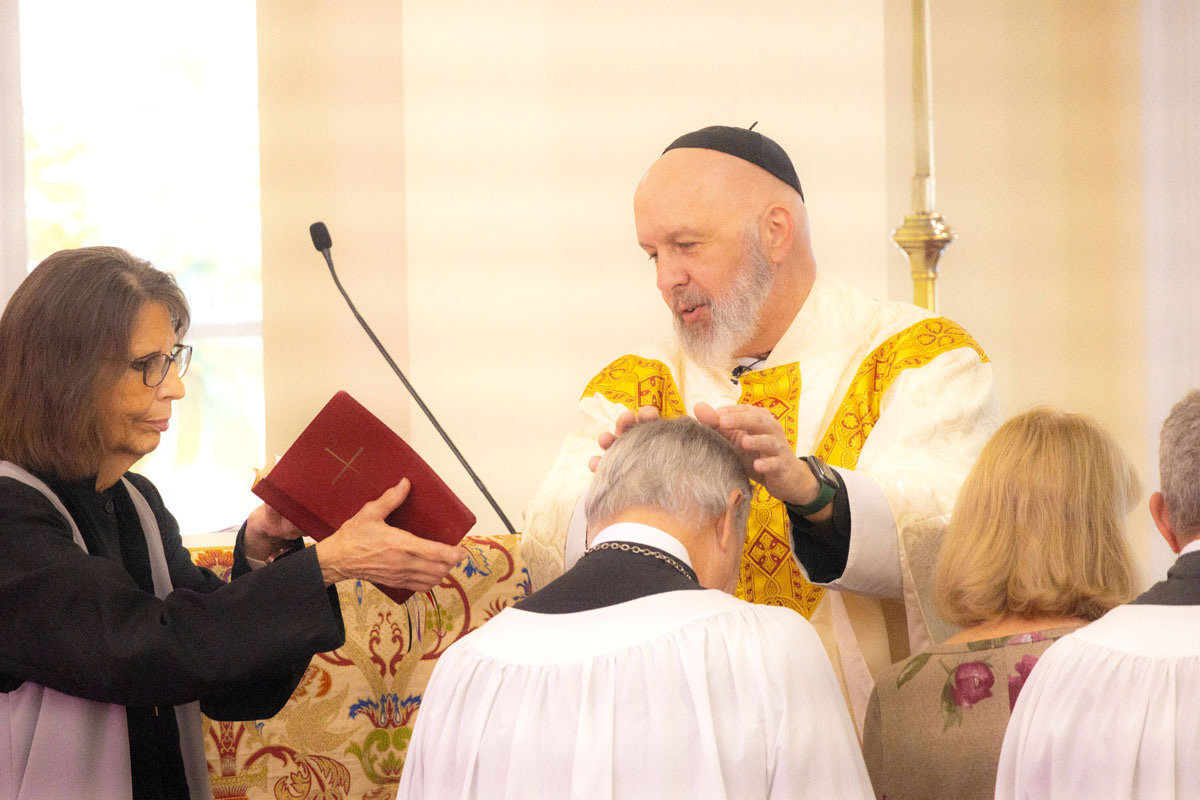
 One of our kids’ favorite programs when they were little was Blue’s Clues. We all loved it – the characters, the design, the songs, but mostly we appreciated the underlying values it held up – kindness, curiosity, openness, wholeheartedness. One of our favorite episodes was a special called “Blue’s Big Musical Movie.” If you haven’t seen it, it’s worth the watch. In it, one character, Sidetable Drawer, has a song called “Sidetable Has a Funny Hat.” As a good Episcopalian, I always thought we could create our own version of the song called “Our Bishop Has a Funny Hat,” but alas, I’m not a songwriter, so it never went anywhere. Several years ago, though, I did write a blogpost called “Why I Wear That Funny Little Hat” to answer the same question that I understand many of you are asking – Why does Fr. Kevin wear that hat? If you don’t know what hat, come to church on Sunday, and you’ll see.
It’s a fair question, and I do have a reason, maybe even a good one. I believe that anything we do in our liturgy should have a reason for it, by the way. If we don’t know why we’re doing a thing, that might be a sign that we should either stop doing it or at the very least develop a good rationale. First things first, though – let’s be clear about what the hat in question is called. It is not a yarmulke (we’re not Jewish), nor is it a skullcap. While similar to both of those, it’s something different, and it’s called a zucchetto. Zucchetto is the diminutive form of the Italian word for gourd, so the word literally means “little gourd.” You may know that gourd is often used to refer to someone’s head, so a zucchetto covers our gourd. I reckon the best alternative English word for a zucchetto is beanie (bean being another term for head).
Why do I wear it, though, no matter what it’s called? That’s the real question, isn’t it? The history of the zucchetto is helpful here. Like most everything we use in our liturgy, the zucchetto started with a very practical purpose that later gained symbolic significance. In the Middle Ages, when monks and clergy took their vows, all or part of their heads were shaved as a sign of humility. That bald area on their heads was called a tonsure; it was a visible sign to everyone that the monk had taken his vows. Over time, people began to refer to “receiving the tonsure” or “being tonsured” to mean they had professed their vows. Because we’re talking about fourteenth century Europe, when monasteries and cathedrals had no means of heat, the poor monks needed some way to protect their bald pates from the bitter cold of winter, and thus the small round zucchetto came into being. They just needed something to cover the shaved patch on top of their heads, so they didn’t freeze. Since the zucchetto was associated with the tonsure, it also came to symbolize their monastic and ordination vows. That’s why I wear it – to remind me of the vows that I have taken as a priest of the Church.
It is true that we have lots of similar symbols of our vows – the black shirt and backwards white collar that clergy wear being the most obvious. Some of those symbols, though, are now so commonplace that I wonder if they haven’t lost at least some of their meaning. Clergy shirts are now available in all sorts of colors and designs, and that’s fine – people can wear whatever suits them. I wanted a symbol that wasn’t common, that we didn’t see every day, something that when I am wearing it is a clear and constant reminder of the vocation that I accepted and of the obligations that accompany that vocation. It is, in some ways, similar to a baseball cap – it signifies what team you’re on. That funny little hat helps me be clear about who I am, whose I am, and how I have promised to live. Some people may not need that reminder, but I find it helpful for me.
I get other questions about it from time to time, so I’ll run through those answers quickly here. I don’t wear it all the time, only when I’m in my vestments. I take it off at certain times during the liturgy – at the reading of the Gospel and at the altar. I didn’t get one because I’m bald; I started wearing it when I still had a full head of hair, but I appreciate it all the more now. Its color denotes order – the pope wears white; cardinals wear red; bishops wear purple; priests wear black. Mine was made by an order of nuns in Rome, and it’s like magic how it just stays on. They really know how to make them. Zucchettos are mostly associated with Roman clergy, but some Anglicans, Episcopalians, and Orthodox clergy also wear them. There are a few other priests in our diocese who wear one but not many. And finally, yes, I know it’s odd, but that’s kind of the point.